How to Create a Calming Bedtime Routine for Children
Written by the Fiabalo Editorial Team · About the Fiabalo team
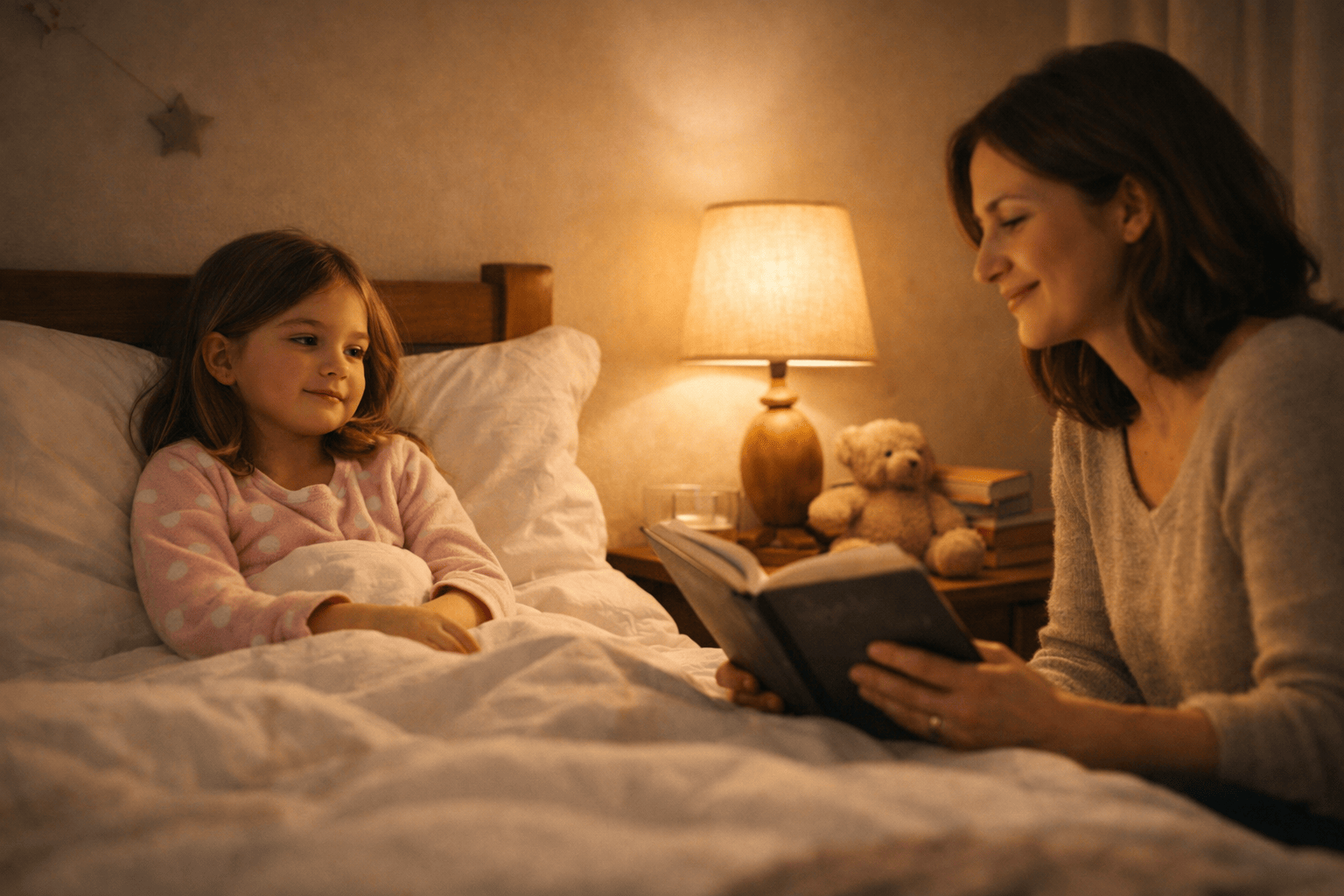
You know that moment when the evening is going perfectly — bath done, teeth brushed, pajamas on — and then your child gets a second wind? Suddenly they're bouncing on the bed, remembering a joke from lunch, or absolutely needing to tell you about a dream they had last Tuesday.
It's not that they're not tired. They almost certainly are. But tired doesn't mean ready to sleep. Children need more than fatigue to fall asleep — they need to feel safe, settled, and guided gently from the noise of the day into the quiet of the night.
That's what a bedtime routine actually does. Not force sleep — prepare for it.
Why routines work (even when it doesn't feel like it)
There's a reason every sleep expert, pediatrician, and experienced parent says the same thing: routine matters. Not because it's a magic formula, but because children's nervous systems are wired to respond to patterns.
When evenings follow a familiar sequence, something shifts in your child's body before they even realize it. The brain starts recognizing cues — dimmer lights, quieter voices, the sound of a story — and begins winding down automatically. Over weeks and months, the routine itself becomes a sleep signal. Your child doesn't need to decide to relax. The pattern does the work.
This is why consistency beats perfection. A simple routine you can actually repeat every night will always outperform an elaborate one that falls apart by Wednesday.
Start with the hardest part: the transition
The trickiest moment in any evening isn't bedtime itself — it's the shift from active to calm. A child who was chasing siblings around the kitchen ten minutes ago isn't going to lie quietly just because you said "it's bedtime."
Instead of treating this as a switch, treat it as a fade. Start lowering the energy before bed. Dim the lights a little. Turn off the TV. Shift from loud play to something quieter — drawing, building with blocks, looking at a book together. Let the evening naturally slow down.
The goal isn't to stop all fun. It's to change the pace gradually enough that your child's body gets the message: we're heading toward rest.
Pick a sequence — and stick with it
The specific steps in your routine matter far less than their order. What works for one family might look completely different from another. But whatever you choose, keep the sequence roughly the same each night.
A simple version might look like this: wash up, pajamas, a quiet activity, a story, lights dim, goodnight. Your version might swap the bath to earlier, add a short conversation about the day, or include a favorite song. All fine. What matters is that your child can predict what comes next without being told.
That predictability is the point. When children know the sequence, they stop asking "what's next?" and start settling into the flow. The negotiation drops. The resistance softens. Not immediately — but over time, reliably.
Put a story at the heart of it
If there's one element worth protecting in your routine, it's the story. Not because stories are the only calming activity — but because they do several things at once that nothing else quite matches.
A calm bedtime story slows the pace of the evening. It gives your child's mind something gentle to focus on, which stops it from racing. It creates a feeling of closeness and warmth. And it provides a natural endpoint — the story finishes, the lights go down, the night begins.
The delivery matters more than the content. A short story told in a warm, unhurried voice works better than a long one rushed through because you're running late. And it doesn't have to come from a book — a story from memory, a made-up tale, a gentle audio story, or a calm narrated story through an app can all carry the same benefits, as long as the tone is right.
Make the bedroom work for you
Your child's sleep environment sends signals too. A bright, noisy, interesting room says "stay awake and explore." A dim, quiet, familiar room says "this is where you rest."
You don't need to redesign anything. Small, consistent adjustments are enough: soft lighting instead of overhead lights, minimal background noise, comfortable bedding, and a favorite stuffed animal or blanket that stays in the same place each night. The more boring and predictable the environment, the more it works.
One thing worth being careful with is highly stimulating media in the wind-down period. Bright, fast-paced, or very interactive content tends to work against sleep readiness. Calm storytelling is different. The more soothing and low-stimulation the bedtime experience feels, the easier it is for your child to settle.
End the same way every night
Many bedtime struggles happen at the very end — when the story is finished but sleep hasn't arrived yet. That gap is where "one more hug," "I need water," and "just one more story" live.
A closing ritual helps bridge that gap. It can be almost anything, as long as it's short, calm, and the same each night: a specific goodnight phrase, a forehead kiss, a whispered "see you in the morning." Something your child can count on as the final note of the day.
The key is that it's an ending, not an opening for negotiation. When the closing ritual is predictable and warm, children accept it more easily — because they know exactly what it is, and they know it means safety, not abandonment.
When the routine stops working
It will happen. A week where bedtime is chaos. A phase where your child suddenly resists everything. A stretch of nights where nothing seems to help.
Usually, this has a reason: a developmental leap, a change at school, travel, illness, or just a phase. The instinct is often to add more control — stricter rules, firmer tone, new consequences. But in most cases, the opposite works better. Strengthen the calm structure. Be more consistent with the routine, not more forceful.
The routine is still doing its job, even when results are temporarily invisible. A child with an established evening rhythm finds their way back to balance faster than one without. Trust the pattern. It's working underneath the surface.
It doesn't need to be long
This is worth repeating, because it's the thing that makes routines sustainable. A bedtime routine doesn't need to take an hour. It doesn't need five steps. It doesn't need to include a bath every single night.
On busy evenings, a routine can be as simple as: pajamas, one short story, goodnight phrase, lights dim. A short version can still be deeply effective when it feels familiar and calm.
The best routine is the one you can actually do every night without dreading it. Because the power isn't in any single element — it's in the repetition.
Sources & research notes
- HealthyChildren.org — Sleep: How Many Hours Does Your Child Need? — Guidance on children’s sleep needs, predictable bedtime habits, screen-free wind-down time, and routines that help support better rest.
- Sleep Foundation — Bedtime Routines for Children — Practical guidance on creating a consistent bedtime routine, lowering evening stimulation, dimming lights, turning off screens, and using calm activities like reading.
- Mindell et al. — Benefits of a Bedtime Routine in Young Children — Research background on how consistent bedtime routines can support children’s sleep, family wellbeing, and calmer evenings.
These sources helped shape this guide. The suggestions are meant to support calmer bedtime moments, not replace medical or developmental advice. Every child is different. If sleep feels persistently difficult or worrying, it is always best to speak with a pediatrician or qualified professional.